(The Exorcist - William Friedkin 1973)
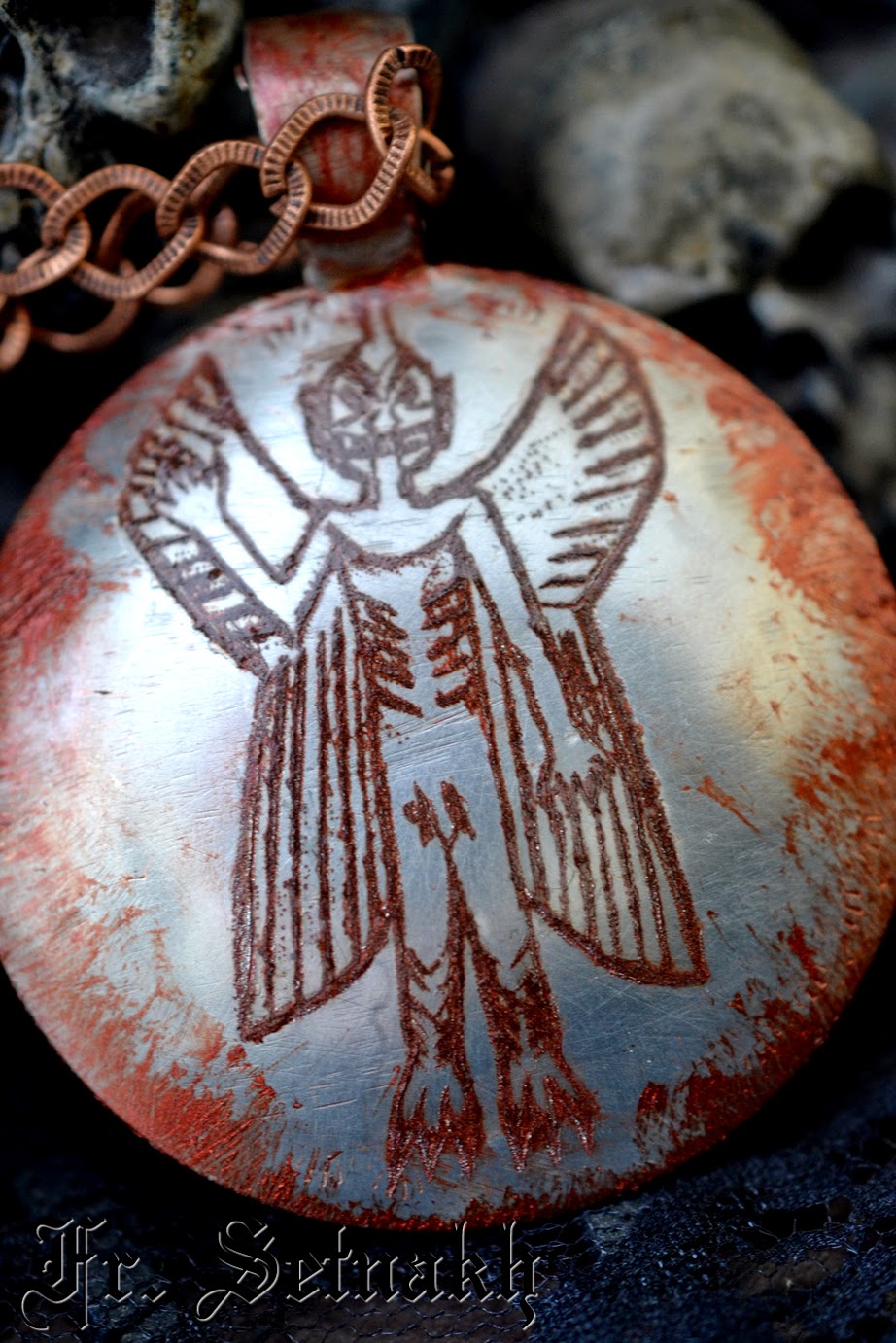
PAZUZU MEDALLION
In Assyrian and Babylonian mythology, Pazuzu was the king of the demons of the wind, and son of the god Hanbi. He also represented the southwestern wind, the bearer of storms and drought.
This medalion is completly hand-made.
It was patinated with copper-colored paint and hand polished.
Diameter: 58mm, length of chain: 55cm.
Material: nickiel silver (alpaca)
2 options to choose from: matt and polished finish.
Made by Frater Setnakh
****
Pazuzu is the son of Hanbi, a God of Whom very little is known, aside from the fact that He is Pazuzu’s father. Wiggermann theorizes that Pazuzu is derived from similar-looking winged figures meant to represent the West wind (134 – 36), and informs us that the derivation of Pazuzu’s image from the “not perfect” (šu-du) “not straight” (si-sá) West wind, often portrayed as a bent, monstrous figure, provides a definite clue as to the meaning of His mysterious father’s name. Hanbi is considered to derive from Babylonian ḫanāp/bu, “to be luxuriant.” This derivation makes no sense in such a context, but there is a West-Semitic alternative in the root HNP, attested in Hebrew and Arabic, meaning “to limp; to be perverted.” A father called “The Limping One” fits Pazuzu’s origin, functions, and grotesque appearance perfectly.
(The Exorcist - William Friedkin 1973)
Concerning Pazuzu’s name itself, Wiggermann offers us two possible solutions. The first, Neo-Assyrian PN Pa-zu-zu, occurs once in a text from Tall Halaf, and is explained as deriving either from Aramaic pezôzā, “made of fine gold,” or from Aramaic PZZ, “to be impetuous, agile.” The latter of this class of derivations fits Pazuzu’s character exceptionally well. Whether the Neo-Assyrian names Ba-su-su and Ba-zu-zu reflect the same meaning for the same entity cannot be known. (136)
The second potential solution is a bit more tenuous. Pasusu would be derived from PSS, an unattested secondary variant of PSH, known in Babylonian from the word pessû — “halt” or “dwarf.” This would place Pasusu in the class of apotropaic dwarfs attested both in Mesopotamian and Egyptian religion and iconography. In fact, on one well-made Lamaštu amulet, Pazuzu has remarkably short legs, and in an inscription calls Himself ú-GU-u, or “cripple.” (Wiggermann, 136)
Wiggermann tells us that Pazuzu’s name is not attested before the Iron Age (1200 – 550 BCE), though “the bilingual [Sumero-Akkadian] incantations can be taken to point to an earlier date, as well as perhaps His appearance in an alamdimmû omen.” (135 – 6) Pazuzu is known from over 170 iconographic representations stemming from the Ancient Near East and beyond during the 1st millennium BCE, from the Late Babylonian and Neo-Assyrian (circa 1000 – 609 BCE) and Neo-Babylonian (circa 626 – 539 BCE) periods. (Gabbay et al., 63)
As mentioned previously, Pazuzu was a later, revised form of conglomerate West wind figures, as well as a variation of and successor to the Ḫumbaba apotropaion of the Bronze Age. (Wiggermann, 134 – 6) The West wind figure made its last appearance in the Mitannian North, and the Ḫumbaba figure went out of style, during the Late Bronze Age; from that point on, Pazuzu dominated much of Ancient Near Eastern iconography as the grotesque apotropaion par excellence. (Wiggermann, 135)
Pazuzu’s appearance is, in a word, unsettling. He is portrayed as a gruesome bipedal chimera of lion (or dog), eagle, scorpion, reptile, and humanoid, with razor-like talons on each hand and foot. Rather than being shown with a normal phallus, Pazuzu’s penis is scaly and serpent-headed. (Black and Green, 147)
It is generally maintained by Art Historians that the incorporation of arachnid and ophidian characteristics in iconography makes a deity capable of protecting against attack from such creatures, or possibly even capable of healing scorpion stings and snake bites, as the Ancient Egyptian Goddess Serket is thought to preside over the determent of scorpions and reversing the effects of their noxious venom. Alternatively, being in possession of such attributes could simply denote the profundity of the vicious, all-encompassing pain and violence Pazuzu is capable of inflicting upon transgressors and malevolent forces.
Wiggermann states that the motive for for Pazuzu’s creation must be looked for in His practical use. (135) Since the iconography and demonology of the previous ages are well documented, and since their character is generally conservative, this sudden appearance cannot be due to a coincidental weakness of the preserved, preexisting traditions; rather, it suggests that Pazuzu’s origin lies in a conscious act, in a purposeful break with the past. (125)
It is in the Late Bronze Age that we find this break from tradition, and our most likely answers as to where and why Pazuzu entered the mythology. It is during this time that Lamaštu — formerly a child-killing demon without any special relation to other demons, nor an arch-nemesis among the Gods or demon-kind — became a member of the lilû-class of demons, which knocked the power structure completely out of balance in the demonic world. (Wiggermann, 135) Consequently, a new position opened up for an equally potent counter-demon, King over all lilû-demons, a monstrous being that would be able to force Lamaštu and her loathsome peers out of the house and back to the dust and darkness of the Underworld.
Thus enters Pazuzu onto the stage. [...]